Holevo’s theorem - Wikipedia
Source: https://en.wikipedia.org/wiki/Holevo%27s_theorem
Ring 2 — Canonical Grounding
- TH Information Theory Bekenstein Bound
- Integrated Information Theory (Tononi)
- Shannon Information Theory
Ring 3 — Framework Connections
Upper bound on the knowable information of a quantum state
Holevo’s theorem is a result in quantum information theory. It is sometimes called Holevo’s bound, since it gives an upper bound on the accessible information, which is amount of information that can be known about a quantum state. It was first published by Alexander Holevo in 1973.
Statement
Setting
Suppose Alice wants to send a classical message to Bob by encoding it into a quantum state, and suppose she can prepare a state from some fixed set
{
ρ
1 , … ,
ρ
n
}
{\displaystyle {\rho _{1},…,\rho _{n}}}

p
i
{\displaystyle p_{i}}

X
{\displaystyle X}

X
{\displaystyle X}
Y
{\displaystyle Y}

Holevo’s theorem bounds the amount of correlation between the classical registers
X
{\displaystyle X}
Y
{\displaystyle Y}
Precise statement
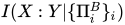
Define the accessible information between
X
{\displaystyle X}
Y
{\displaystyle Y}
I
a c c ( X : Y )
sup
{
Π
i
B
}
i I ( X : Y
| {
Π
i
B
}
i
)
,
{\displaystyle I_{\rm {acc}}(X:Y)=\sup _{{\Pi _{i}^{B}}_{i}}I(X:Y|{\Pi _{i}^{B}}_{i}),}

I ( X : Y
| {
Π
i
B
}
i
)
{\displaystyle I(X:Y|{\Pi _{i}^{B}}_{i})}
p
i j
p
i Tr (
Π
j
B
ρ
i
)
{\displaystyle p_{ij}=p_{i}\operatorname {Tr} (\Pi _{j}^{B}\rho _{i})}

I
a c c ( X : Y ) ≤ χ ( η ) ≡ S
(
∑
i
p
i
ρ
i ) −
∑
i
p
i S (
ρ
i
)
,
{\displaystyle I_{\rm {acc}}(X:Y)\leq \chi (\eta )\equiv S\left(\sum _{i}p_{i}\rho _{i}\right)-\sum _{i}p_{i}S(\rho _{i}),}

η ≡ { (
p
i ,
ρ
i )
}
i
{\displaystyle \eta \equiv {(p_{i},\rho _{i})}_{i}}
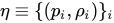
S
{\displaystyle S}

χ
(
η
)
{\displaystyle \chi (\eta )}

The Holevo information is also equal to the quantum mutual information of the classical-quantum state corresponding to the ensemble:
χ ( η )
I
(
∑
i
p
i
| i ⟩
⟨ i
| ⊗
ρ
i
)
,
{\displaystyle \chi (\eta )=I\left(\sum _{i}p_{i}|i\rangle !\langle i|\otimes \rho _{i}\right),}
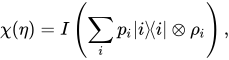
I (
ρ
A B ) ≡ S (
ρ
A ) + S (
ρ
B ) − S (
ρ
A
B
)
{\displaystyle I(\rho _{AB})\equiv S(\rho _{A})+S(\rho _{B})-S(\rho _{AB})}

ρ
A
B
{\displaystyle \rho _{AB}}

Proof
Consider the composite system that describes the entire communication process, which involves Alice’s classical input
X
{\displaystyle X}
Q
{\displaystyle Q}

Y
{\displaystyle Y}
X
{\displaystyle X}
ρ
X :=
∑
x
1
n
p
x
| x ⟩ ⟨ x
|
{\displaystyle \rho ^{X}:=\sum \nolimits _{x=1}^{n}p_{x}|x\rangle \langle x|}

{
| x ⟩
}
x
1
n
{\displaystyle {|x\rangle }_{x=1}^{n}}

X
{\displaystyle X}
S
(
X
)
{\displaystyle S(X)}

ρ
X
{\displaystyle \rho ^{X}}

H
(
X
)
{\displaystyle H(X)}

{
p
x
}
x
1
n
{\displaystyle {p_{x}}_{x=1}^{n}}

: S ( X ) = − tr
(
ρ
X
log
ρ
X
)
=
−
tr
(
∑
x
=
1
n
p
x
log
p
x
|
x
⟩
⟨
x
|
)
=
−
∑
x
=
1
n
p
x
log
p
x
=
H
(
X
)
.
{\displaystyle S(X)=-\operatorname {tr} \left(\rho ^{X}\log \rho ^{X}\right)=-\operatorname {tr} \left(\sum \_{x=1}^{n}p\_{x}\log p\_{x}|x\rangle \langle x|\right)=-\sum \_{x=1}^{n}p\_{x}\log p\_{x}=H(X).}

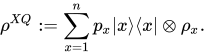
The initial state of the system, where Alice prepares the state
ρ
x
{\displaystyle \rho _{x}}

p
x
{\displaystyle p_{x}}

: ρ
X
Q
:=
∑
x
=
1
n
p
x
|
x
⟩
⟨
x
|
⊗
ρ
x
.
{\displaystyle \rho ^{XQ}:=\sum \_{x=1}^{n}p\_{x}|x\rangle \langle x|\otimes \rho \_{x}.}
Afterwards, Alice sends the quantum state to Bob. As Bob only has access to the quantum system
Q
{\displaystyle Q}
X
{\displaystyle X}
ρ :=
tr
X
(
ρ
X Q )
∑
x
1
n
p
x
ρ
x
{\displaystyle \rho :=\operatorname {tr} _{X}\left(\rho ^{XQ}\right)=\sum \nolimits _{x=1}^{n}p_{x}\rho _{x}}

{
E
y
}
y
1
m
{\displaystyle {E_{y}}_{y=1}^{m}}

{
q
y
}
y
1
m
{\displaystyle {q_{y}}_{y=1}^{m}}

y
1
,
2
,
…
,
m
{\displaystyle y=1,2,\dots ,m}

Y
{\displaystyle Y}
: E
Q
(
ρ
x
)
=
∑
y
=
1
m
q
y
|
x
ρ
y
|
x
⊗
|
y
⟩
⟨
y
|
,
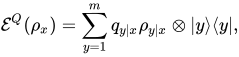
{\displaystyle {\mathcal {E}}^{Q}(\rho \_{x})=\sum \_{y=1}^{m}q\_{y|x}\rho \_{y|x}\otimes |y\rangle \langle y|,}
where
q
y
| x
tr
(
E
y
ρ
x
)
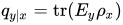
{\displaystyle q_{y|x}=\operatorname {tr} \left(E_{y}\rho _{x}\right)}
y
{\displaystyle y}

ρ
x
{\displaystyle \rho _{x}}
ρ
y
| x
W
E
y
ρ
x
E
y
W
†
/
q
y
|
x
{\displaystyle \rho _{y|x}=W{\sqrt {E_{y}}}\rho _{x}{\sqrt {E_{y}}}W^{\dagger }/q_{y|x}}

W
{\displaystyle W}

: ρ
X

Q
′
Y
:=

[

I

X
⊗

E

Q
]

(

ρ

X
Q
)
=

∑

x
=
1

n

∑

y
=
1

m

p

x

q

y

|
x

|
x
⟩
⟨
x

|
⊗

ρ

y

|
x
⊗

|
y
⟩
⟨
y

|
.
{\displaystyle \rho ^{XQ'Y}:=\left[{\mathcal {I}}^{X}\otimes {\mathcal {E}}^{Q}\right]\!\left(\rho ^{XQ}\right)=\sum \_{x=1}^{n}\sum \_{y=1}^{m}p\_{x}q\_{y|x}|x\rangle \langle x|\otimes \rho \_{y|x}\otimes |y\rangle \langle y|.}
![{\displaystyle \rho ^{XQ'Y}:=\left[{\mathcal {I}}^{X}\otimes {\mathcal {E}}^{Q}\right]\!\left(\rho ^{XQ}\right)=\sum _{x=1}^{n}\sum _{y=1}^{m}p_{x}q_{y|x}|x\rangle \langle x|\otimes \rho _{y|x}\otimes |y\rangle \langle y|.}](https://wikimedia.org/api/rest_v1/media/math/render/svg/eb7bd4c52bfd1108927565e64519860aeae18c50)
Here
I
X
{\displaystyle {\mathcal {I}}^{X}}

X
{\displaystyle X}
E
Q
{\displaystyle {\mathcal {E}}^{Q}}

S ( X :
Q
′
Y
)
≤
S
(
X
:
Q
)
{\displaystyle S(X:Q’Y)\leq S(X:Q)}

Q
′
{\displaystyle Q’}

S ( X : Y ) ≤ S ( X :
Q
′
Y
)
{\displaystyle S(X:Y)\leq S(X:Q’Y)}

: S
(
X
:
Y
)
≤
S
(
X
:
Q
)
.
{\displaystyle S(X:Y)\leq S(X:Q).}

On the left-hand side, the quantities of interest depend only on
: ρ
X
Y
:=
tr
Q
′
(
ρ
X
Q
′
Y
)
=
∑
x
=
1
n
∑
y
=
1
m
p
x
q
y
|
x
|
x
⟩
⟨
x
|
⊗
|
y
⟩
⟨
y
|
=
∑
x
=
1
n
∑
y
=
1
m
p
x
,
y
|
x
,
y
⟩
⟨
x
,
y
|
,
{\displaystyle \rho ^{XY}:=\operatorname {tr} \_{Q'}\left(\rho ^{XQ'Y}\right)=\sum \_{x=1}^{n}\sum \_{y=1}^{m}p\_{x}q\_{y|x}|x\rangle \langle x|\otimes |y\rangle \langle y|=\sum \_{x=1}^{n}\sum \_{y=1}^{m}p\_{x,y}|x,y\rangle \langle x,y|,}

with joint probabilities
p
x , y
p
x
q
y
|
x
{\displaystyle p_{x,y}=p_{x}q_{y|x}}

ρ
X
Y
{\displaystyle \rho ^{XY}}

ρ
Y :=
tr
X (
ρ
X
Y
)
{\displaystyle \rho ^{Y}:=\operatorname {tr} _{X}(\rho ^{XY})}

ρ
X
{\displaystyle \rho ^{X}}
: S
(
X
:
Y
)
=
S
(
X
)
+
S
(
Y
)
−
S
(
X
Y
)
=
H
(
X
)
+
H
(
Y
)
−
H
(
X
Y
)
=
I
(
X
:
Y
)
.
{\displaystyle S(X:Y)=S(X)+S(Y)-S(XY)=H(X)+H(Y)-H(XY)=I(X:Y).}

Meanwhile,
S
(
X
:
Q
)
{\displaystyle S(X:Q)}

: log
ρ
X
Q
=
log
(
∑
x
=
1
n
p
x
|
x
⟩
⟨
x
|
⊗
ρ
x
)
=
∑
x
=
1
n
|
x
⟩
⟨
x
|
⊗
log
(
p
x
ρ
x
)
=
∑
x
=
1
n
log
p
x
|
x
⟩
⟨
x
|
⊗
I
Q
+
∑
x
=
1
n
|
x
⟩
⟨
x
|
⊗
log
ρ
x
,
{\displaystyle \log \rho ^{XQ}=\log \left(\sum \_{x=1}^{n}p\_{x}|x\rangle \langle x|\otimes \rho \_{x}\right)=\sum \_{x=1}^{n}|x\rangle \langle x|\otimes \log \left(p\_{x}\rho \_{x}\right)=\sum \_{x=1}^{n}\log p\_{x}|x\rangle \langle x|\otimes I^{Q}+\sum \_{x=1}^{n}|x\rangle \langle x|\otimes \log \rho \_{x},}

where
I
Q
{\displaystyle I^{Q}}

Q
{\displaystyle Q}
: S ( X : Q )
=
S
(
X
)
+
S
(
Q
)
−
S
(
X
Q
)
=
S
(
X
)
+
S
(
ρ
)
+
tr
(
ρ
X
Q
log
ρ
X
Q
)
=
S
(
X
)
+
S
(
ρ
)
+
tr
(
∑
x
=
1
n
p
x
log
p
x
|
x
⟩
⟨
x
|
⊗
ρ
x
)
+
tr
(
∑
x
=
1
n
p
x
|
x
⟩
⟨
x
|
⊗
ρ
x
log
ρ
x
)
=
S
(
X
)
+
S
(
ρ
)
+
tr
(
∑
x
=
1
n
p
x
log
p
x
|
x
⟩
⟨
x
|
)
⏟
−
S
(
X
)
+
tr
(
∑
x
=
1
n
p
x
ρ
x
log
ρ
x
)
=
S
(
ρ
)
+
∑
x
=
1
n
p
x
tr
(
ρ
x
log
ρ
x
)
⏟
−
S
(
ρ
x
)
=
S
(
ρ
)
−
∑
x
=
1
n
p
x
S
(
ρ
x
)
,
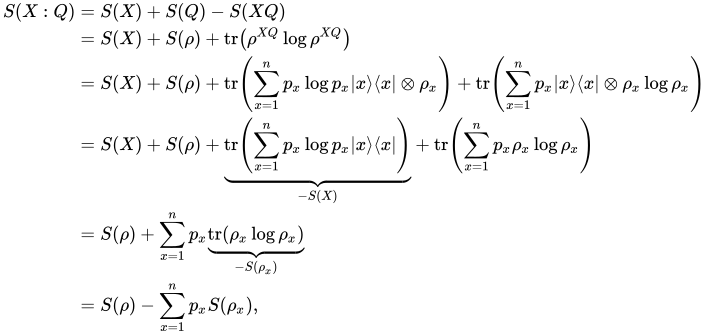
{\displaystyle {\begin{aligned}S(X:Q)&=S(X)+S(Q)-S(XQ)\\&=S(X)+S(\rho )+\operatorname {tr} \left(\rho ^{XQ}\log \rho ^{XQ}\right)\\&=S(X)+S(\rho )+\operatorname {tr} \left(\sum \_{x=1}^{n}p\_{x}\log p\_{x}|x\rangle \langle x|\otimes \rho \_{x}\right)+\operatorname {tr} \left(\sum \_{x=1}^{n}p\_{x}|x\rangle \langle x|\otimes \rho \_{x}\log \rho \_{x}\right)\\&=S(X)+S(\rho )+\underbrace {\operatorname {tr} \left(\sum \_{x=1}^{n}p\_{x}\log p\_{x}|x\rangle \langle x|\right)} \_{-S(X)}+\operatorname {tr} \left(\sum \_{x=1}^{n}p\_{x}\rho \_{x}\log \rho \_{x}\right)\\&=S(\rho )+\sum \_{x=1}^{n}p\_{x}\underbrace {\operatorname {tr} \left(\rho \_{x}\log \rho \_{x}\right)} \_{-S(\rho \_{x})}\\&=S(\rho )-\sum \_{x=1}^{n}p\_{x}S(\rho \_{x}),\end{aligned}}}
which completes the proof.
Comments and remarks
In essence, the Holevo bound proves that given n qubits, although they can “carry” a larger amount of (classical) information (thanks to quantum superposition), the amount of classical information that can be retrieved, i.e. accessed, can be only up to n classical (non-quantum encoded) bits. It was also established, both theoretically and experimentally, that there are computations where quantum bits carry more information through the process of the computation than is possible classically.
See also
- Classical capacity
- Superdense coding
References
- ^ Preskill, John (June 2016). “Chapter 10. Quantum Shannon Theory” (PDF). Quantum Information. pp. 23–24. Retrieved 30 June 2021.
- ^ Maslov, Dmitri; Kim, Jin-Sung; Bravyi, Sergey; Yoder, Theodore J.; Sheldon, Sarah (2021-06-28). “Quantum advantage for computations with limited space”. Nature Physics. 17 (8): 894–897. arXiv:2008.06478. Bibcode:2021NatPh..17..894M. doi:10.1038/s41567-021-01271-7. S2CID 221136153.
Further reading
- Holevo, Alexander S. (1973). “Bounds for the quantity of information transmitted by a quantum communication channel”. Problems of Information Transmission. 9: 177–183.
- Nielsen, Michael A.; Chuang, Isaac L. (2000). Quantum Computation and Quantum Information. Cambridge, UK: Cambridge University Press. ISBN 978-0-521-63235-5. OCLC 43641333. (see page 531, subsection 12.1.1 - equation (12.6) )
- Wilde, Mark M. (2011). “From Classical to Quantum Shannon Theory”. arXiv:1106.1445v2 [quant-ph].. See in particular Section 11.6 and following. Holevo’s theorem is presented as exercise 11.9.1 on page 288.
| * v * t * e Quantum information science | |
|---|---|
| General | * DiVincenzo’s criteria * NISQ era * Quantum computing + timeline * Quantum information * Quantum programming * Quantum simulation * Qubit + physical vs. logical * Quantum processors + cloud-based |
| Theorems | * Bell’s * Eastin–Knill * Gleason’s * Gottesman–Knill * Holevo’s * No-broadcasting * No-cloning * No-communication * No-deleting * No-hiding * No-teleportation * PBR * Quantum speed limit * Threshold * Solovay–Kitaev * Schrödinger-HJW |
| Quantum communication | * Classical capacity + entanglement-assisted + quantum capacity * Entanglement distillation * Entanglement swapping * Monogamy of entanglement * LOCC * Quantum channel + quantum network * State purification * Quantum teleportation + quantum energy teleportation + quantum gate teleportation * Superdense coding |
| Quantum algorithms | * Algorithmic cooling * Amplitude amplification * Bernstein–Vazirani * BHT * Boson sampling * Deutsch–Jozsa * Grover’s * HHL * Hidden subgroup * Magic state distillation * Quantum annealing * Quantum counting * Quantum Fourier transform * Quantum optimization * Quantum phase estimation * Shor’s * Simon’s * VQE |
| Quantum complexity theory | * BQP * DQC1 * EQP * QIP * QMA * PostBQP |
| Quantum processor benchmarks | * Quantum supremacy * Quantum volume * QC scaling laws * Randomized benchmarking + XEB * Relaxation times + T1 + T2 |
| Quantum computing models | * Adiabatic quantum computation * Continuous-variable quantum information * One-way quantum computer + cluster state * Quantum circuit + quantum logic gate * Quantum machine learning + quantum neural network * Quantum Turing machine * Topological quantum computer * Hamiltonian quantum computation |
| Quantum error correction | * Codes + 5 qubit + CSS + GKP + quantum convolutional + stabilizer + Shor + Bacon–Shor + Steane + Toric + gnu * Entanglement-assisted |
| Physical implementations | |
| Quantum programming | * OpenQASM–Qiskit–IBM QX * Quil–Forest/Rigetti QCS * Cirq * Q# * libquantum * many others… |
| * Quantum information science * Quantum mechanics topics |
Retrieved from “https://en.wikipedia.org/w/index.php?title=Holevo%27s\_theorem&oldid=1326359905”
Canonical Hub: CANONICAL_INDEX